
Education
Are you a life-long learner of heavenly wisdom?
Some want an education to satisfy their curiosity. Others dream of enhancing their employability or earnings potential. Still others hope of changing the world for the better. There are many organizations that can help you with those aspirations. They can teach you the “what.”
Our education program can help you with that too. However, the main thrust of our praxis of Christian education is to empower the Christian to know God more, so that he/she can obey and worship Him more. This ultimately means an emphasis on the “Who” as the “Why” and therefore the “How.” With these, you will be able to love Him and therefore others better.
In other words, Christ-conforming education doesn’t just help you perform better by telling you something for the sake of recalling it when someone asks you about it. It is designed to show you who God is, so that you can not only recognize Him, but for the express purpose of loving Him and others by becoming more like Him.
Confessions
God knows what we’re up against. He even tells us more about this than we want to know. But He does this so that we can know what we’re up against, and why we can have hope against all the odds.
- Everything we need to know is in the Bible. It’s clearly written by the only One who can see clearly, and given to us so that we can begin to see clearly too. These things have been summed up in a couple of easily referenced structures through the years.
- The Apostles’ Creed and Nicene Creed are two high-level statements of beliefs that many Christians subscribe to.
- The Westminster Confession of Faith is one of the more detailed ones that get deeper into summarizing what we believe and how we live.
Curricula
Our education program draws from the books of the Bible. This is straightforward: the whole counsel of God and the creeds, confessions, and catechisms that summarize it.
Primary Texts:
- For the ethos program, special emphasis is placed on the wisdom literature within both the Old Testament (viz., Proverbs, Job, Ecclesiastes, Song of Songs, Lamentations, Psalms) and the New Testament (i.e., James).
- The logos program’s curriculum comprises the Nicene Creed, the Westminster Confession of Faith, and the Westminster Shorter and Longer Catechisms as well as the Heidelberg Catechism. These serve as introductions and entry points to the Scripture that they are based on.
- The curriculum for the pathos program draws from the Gospel accounts and the Epistles.
Secondary Texts:
Beyond this, the curriculum contains works from the Puritans and texts that students read at reformed seminaries (e.g., Augustine, Calvin), with abridged versions tailored for the age of the student. This means that a child or teenager can have the opportunity to learn the same heavenly wisdom as an MDiv candidate seeking to be licensed as an ordained pastor, even if it is at a more basic, age-appropriate level.
Seminary Overlaps:
If you have already graduated from a seminary that trains Bible specialists (e.g.., Westminster Theological Seminary) or a seminary that forms pastors (e.g.., Greenville Presbyterian Theological Seminary), you will find thematic overlaps with content from prominent professors old (e.g., Bavinck, Hodge, Machen, Tipton, Van Til, Vos) and new (e.g., McGraw, Morales, Pipa). These are opportunities to go deeper into God’s truth regarding interpersonal dynamics and apply them in the richer nuances of private ministry settings.
Books Curated / Reviewed by ICCCED-T
We are honored to curate and review many books published by our partners (e.g., New Growth Press, Reformed Heritage Books, InterVarsity Press).
Whether you are on the certification journey or part of our book club, we pray these resources will be a boon to you.
To support your Christ-conforming educational process, we humbly offer:
- objective commentary on how the interpretations of well-respected theologians align with the Spirit-superintended words of the Holy Bible, and
- subjective suggestions as to where these perspectives can be extended or adjusted for the contemporary, private ministry setting.
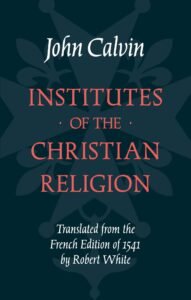
Institutes (Calvin)
One of the key texts to emerge from the Reformation of the sixteenth century, the Institutes offers a clear and comprehensive account of the work of Father, Son, and Holy Spirit in creation, revelation, and redemption in the life of the individual Christian and in the worship and witness of the church.
Not doctrine only but its practical use is Calvin’s abiding concern. The author of the Institutes invites us both to know and to live the truth, and thus allow God’s Spirit to transform us.
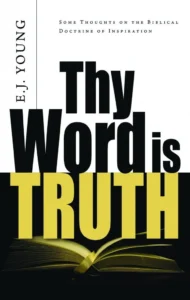
Thy Word is Truth (Young)
Thy Word is Truth explains the importance of the doctrine of biblical inspiration. Without it the reliability of the Bible is in serious doubt, the integrity of Jesus is put in question, and the only final authority men have in matters of faith becomes their own conscience. If we cannot trust what Scripture says about itself, how can we trust what it says about God, about man’s need, or about Christ’s saving power?
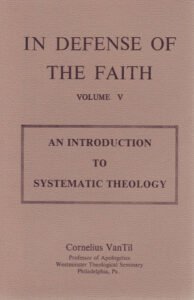
Systematic Theology (Van Til)
Cornelius Van Til (1895–1987) was born in Grootegast, the Netherlands, and immigrated with his family to America in 1905. He attended Calvin College and Calvin Seminary before completing his studies at Princeton Theological Seminary and Princeton University with the ThM and PhD degrees. Drawn to the pastorate, Van Til spent one year in the ministry before taking a leave of absence to teach apologetics at Princeton Seminary. When the seminary reorganized, he was persuaded to join the faculty of the newly founded Westminster Theological Seminary. He remained there as professor of apologetics until his retirement in 1975. Van Til wrote more than twenty books, in addition to more than thirty syllabi.
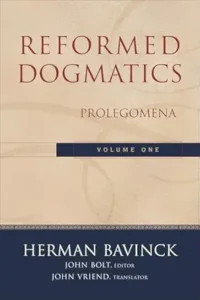
Reformed Dogmatics (Bavinck)
Bavinck’s approach throughout is meticulous. As he discusses the standard topics of dogmatic theology, he stands on the shoulders of giants such as Augustine, John Calvin, Francis Turretin, and Charles Hodge. This masterwork will appeal to scholars and students of theology, research and theological libraries, and pastors and laity who read serious works of Reformed theology.
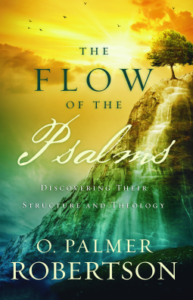
The Flow of the Psalms (Robertson)
O. Palmer Robertson equips us to see a clear redemptive-historical progression that develops across the five books of Psalms. With the aid of charts in full color, he demonstrates how an intentional structure is indicated by elements such as the placement of acrostic psalms, strategic couplings of Messianic psalms with Torah psalms, and the grouping of psalms by topics.
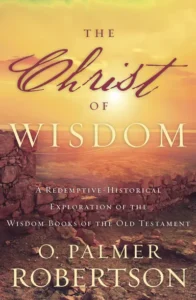
The Christ of Wisdom (Robertson)
O. Palmer Robertson introduces the concept of biblical wisdom before providing a redemptive-historical analysis of Job, Proverbs, Ecclesiastes, Song of Songs, and Lamentations. These neglected books offer the contemporary reader inspired insight (and a solid dose of godly realism) into every major realm of human existence: from love and intimacy to grief and calamity.
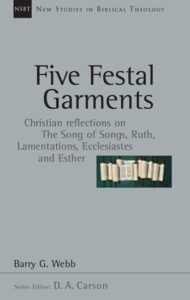
The Five Festal Garments (Webb)
This book punches above its weight as a Christian interpretation of the five Old Testament Scrolls known for being problematic writings. The author allows each book to set its own agenda, and then examines each in relation to the wider Old Testament and to the New Testament gospel with its basic structure of promise and fulfillment. In this way, fresh and illuminating perspectives are presented on these five “festal garments” of love, kindness, suffering, vexation and deliverance.
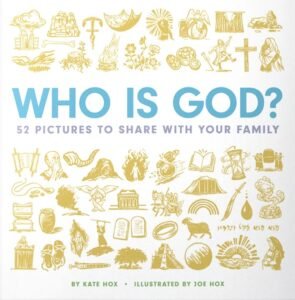
Who Is God? 52 Pictures to Share with Your Family (Hox)
Who Is God? invites families to get to know God better through fifty-two devotions and pictures that display his attributes, characteristics, and names. When you meet a new friend, how do you get to know them? You might ask their name, then what they’re interested in. What are their likes and dislikes? The more time you spend with them, the more you get to know them. It’s similar with God. As we spend time with God in his Word, we get to know him better. We learn his names, his attributes, and the different ways he reveals himself through stories, symbols, and imagery in Scripture.
Grounded in the Gospel (Packer & Parrett)
Historically, the church’s ministry of grounding new believers in the essentials of the faith has been known as catechesis–systematic instruction in faith foundations, including what we believe, how we pray and worship, and how we conduct our lives. For most evangelicals today, however, this very idea is an alien concept. Packer and Parrett, concerned for the state of the church, seek to inspire a much needed evangelical course correction.
Exploring the History and Philosophy of Christian Education (Anthony & Benson)
In this insightful book, two leading scholars in Christian education trace the history of the discipline from the Old Testament to the present. Presented against the backdrop of wider philosophical thought and historical events, Anthony and Benson show how each successive era shaped the practice of Christian education today. The result is a book brimming with insights that reveal the historical roots and philosophical underpinnings of issues relevant to current practice in Christian education ministries.
The Sacrifice of Praise (Bavinck)
In The Sacrifice of Praise, Herman Bavinck pastorally guides the reader through the importance of the public profession of faith. Bavinck’s careful treatment includes explorations of the unifying power of a common (ecumenical) confession of faith, the blessing of the diversity of believers, and reasonable instruction for those facing persecution for publicly identifying with Christ. Theological, practical, straightforward, and devotional, The Sacrifice of Praise gives readers a fresh appreciation for the importance of confessing one’s faith.
The Theology of Education (Richards)
This book focuses on the life offered by Christ as the foremost of theological concepts that form the content and underlie the method of Christian education. It is presented in a warm-hearted and compelling way, with the biblical principles by which the education of children, youth, and older people in the church can become a vital process of growth and continual renewal. Emphasis is placed on a “whole-person” focus and the involvement of the entire church community.
Books Published by ICCCED-T
We are honored to curate and review many books published by our partners (e.g., New Growth Press, Reformed Heritage Books).
To support your Christ-conforming educational process, we humbly offer:
- objective commentary on how the interpretations of well-respected theologians align with the Spirit-superintended words of the Holy Bible, and
- subjective thoughts on where these perspectives can be extended or adjusted for the contemporary, private ministry setting.
Practical Theology
Theology is the study of God. That is a simple enough translation from the Greek: theos is God and “ology” is study. However, those who consider themselves as Christians who follow Reformed classical Trinitarianism as detailed in the Westminster Confession of Faith, who recognize that theology can only be understood when we presuppose that only God can speak authoritatively on Himself, and therefore, any theology would require hearing God’s words as He speaks regarding Himself.
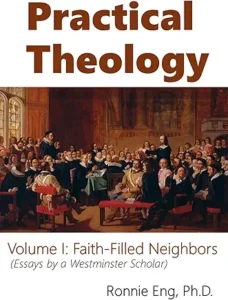
Volume I: Faith-Filled Neighbors
A series of essays that speak to a missionary’s experience making sense of the corporate and home environments.
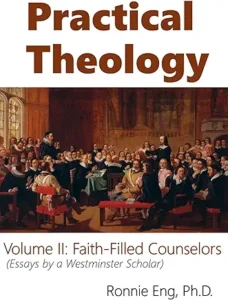
Volume II: Faith-Filled Counselors
A series of essays that speak to a seminarian’s view of how counselors can make sense of their discipline through the lens of Scripture.